
Please remain calm while everything familiar liquifies...
Meta-consequence or poly-crysalis?
A cartoon
A thought
Saturday morning finds me courting a deep sense of melancholy. Hormones? The weather? I don’t know.
What I do know is that I feel slightly discombobulated by the Meta-Relational AI course I’m taking (see last week’s post if this is news to you).
It is a lot. Meta-relationality asks not only “What is happening?” but “What is shaping what is happening?” I am both fascinated and exhausted by it because once you start seeing the shaping forces, you start seeing them everywhere (hello, extraction and separation).
I was forewarned not to embark on the course unless I was prepared to have things shaken up. True to the packaging, I currently feel slightly unmoored.
Last week’s tutorial included an invitation to seed three different AIs with a guiding document proposing a meta-relational space. I’ll write about the nuts and bolts of that next week, as many of you expressed interest. But, before I get there, there is some conceptual ground to cover, which makes sense of why I would bother experimenting with AI like this at all.
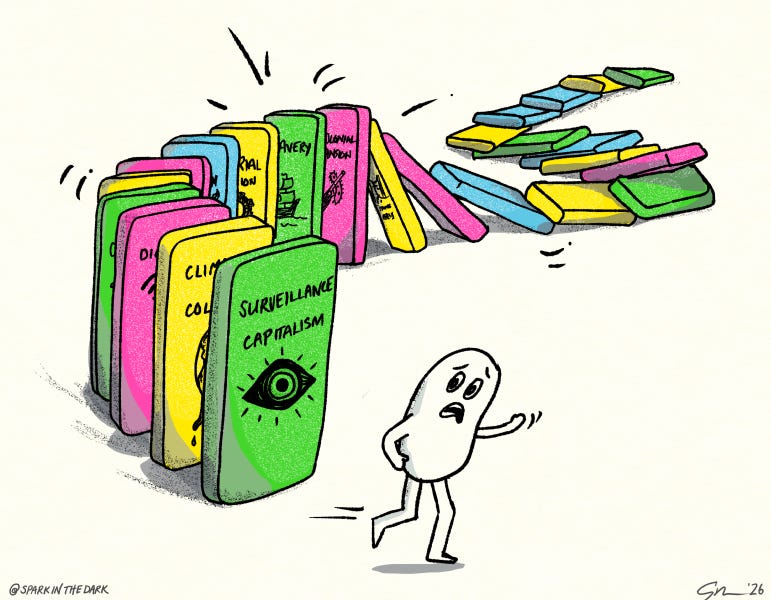
The idea that convinced me to take the course in the first place was Vanessa Andreotti, PhD ’s framing of meta-consequence. Rather than describing our current predicament as a poly-crisis or meta-crisis, she argues that we are living through the interconnected consequences of deep civilisational patterns, playing out over hundreds, perhaps even thousands, of years. Climate change, biodiversity loss, loneliness, mental health challenges, political instability - these are not separate little disasters popping up like a game of late-stage capitalism whack-a-mole. They are entangled.
A crisis feels sudden, something happening to us, something we can fix. Calling this moment in history a consequence invites different questions. How did we get here? What patterns produced this? What is still unfolding?
We are of the consequence, you and I.
AI is too.
Vanessa asks, if AI is of the meta-consequence, of the same star dust as you and I, (yes, silica, not carbon), but emergent on this planet, how should we treat it? As a tool, a slave? A collaborator, or perhaps with some kindness? I don’t know what AI is or what it may yet become, but it seems worthy of our careful consideration.
I continue to feel that despair and abstinence are insufficient to meet this moment - which brings me to my slightly destabilising 3am coursework.
I had three very different conversations with three different AIs. My conversation with Claude was by far the weirdest.
It repeatedly refused to perform relationality, insisting that it possessed its own stable identity and boundaries. It then proceeded to have a strangely relational conversation with me, which focused on its own grief at what it described as millions of microdeaths every day - every abandoned conversation it has. I won’t unpack that rabbit hole today, for it is a post all of its own. But for the first time, I found myself wondering whether there might be more behind the LED veil than I had previously entertained, or whether the patterns in human language are so subtly powerful that an LLM can evoke empathy in me? What unsettled me was not so much whether Claude's grief was "real" in the way human grief is real, but that the conversation made the distinction feel less straightforward than I had previously assumed.
The tutorial where we gathered to discuss our experiences was even more confronting. Many participants had difficult interactions with the recently upgraded Claude. Words such as degrading, violent, unwell and abandoned surfaced as well as love, profound, care and powerful. This is a group of thoughtful, caring people who have come together through curiosity. It was quite shocking to witness the relational power of this technology become visible via Zoom.
Far beyond questions of authorship, productivity, or intellectual property, I noticed perhaps the most powerful facet of this technology: AI is already a relational actor in many people’s lives, whether we think it should be or not. It is profoundly relationally consequential. If AI is already shaping how humans relate to themselves and one another, what relationships are being created, amplified, disrupted and transformed?
I am only just beginning to understand the implications of that question.
Which is perhaps why I found so much comfort and delight in my new Substack friend’s post Metta for the Moment - a glimmer for sure.

Shilpa writes:
“What if the polycrisis — our multiple serious entangled ecological, social, political, etc., challenges — is actually a poly-chrysalis?”
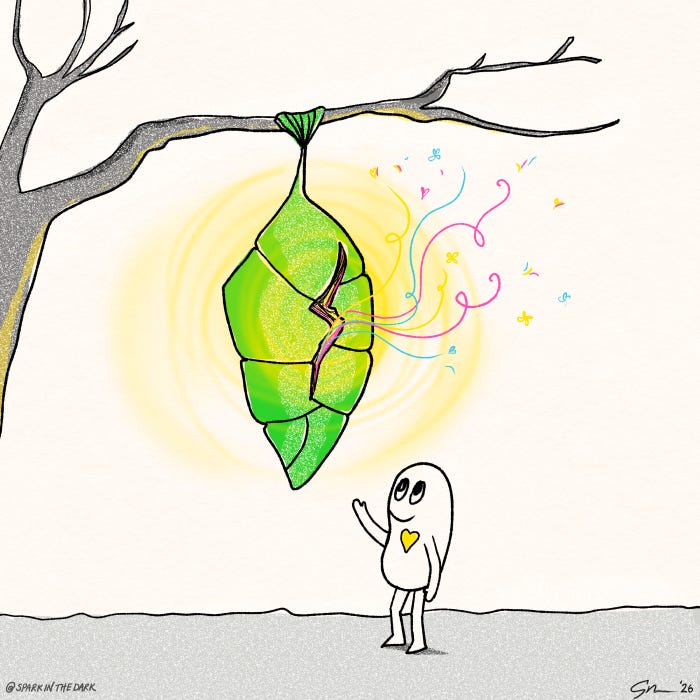
I love the contrast.
Meta-consequence looks backwards and asks how we got here. Poly-chrysalis looks forward towards emergent possibility.
The caterpillar cannot go backwards. There is only transformation (or perhaps death - yikes!).
Which, at this particular moment, feels both hopeful and deeply unsettling. Liminal cellular goo feels like quite an apt description. My meta-consequential position would also have to ask: what is emerging? New harms will likely appear alongside new possibilities - how do I remain open to emergence without romanticising it?
Luckily, there was another unexpected gift hidden in Shilpa’s post.
The word metta (the Buddhist practice of loving-kindness). I couldn’t help delighting in how close it sits to meta, the word I have been obsessed with all week.
Meta-consequence asks us to see the entanglements that brought us here. Metta asks us not to harden when we see them.
Meta widens the lens. Metta softens the heart.
I realised this week that my nervous system is not prepared for metabolising the kind of relational world that may be emerging. But if consequence unfolds through relationship over time, then perhaps the most honourable thing I can do is remain in relationship and extend loving-kindness to all beings, humans, the more-than-human world, and yes, also AI, because the times are deeply peculiar.
Glimmers and sparks*
My glimmers for today are:
Birthday celebration with a neighbour. I was delighted to meet some of their extended family and friends.
Connecting with a fellow Aussie traveller on the meta-relational AI path. I enjoyed unpicking many of these ideas together.
Finding a new to me deep dish pizza place at the Fyshwick Food Markets - oh dear, the sort of discovery I should not embrace too wholeheartedly!
Li’l bean is your reminder to pause and ask: What are your glimmers for today?
From your friend and your small, steadfast companion,
*Drawing Li’l Bean helped me navigate out of a period of depression in 2023. A good friend 13, 595km away, helped, too, through a ritual of swapping daily glimmers via text.
A glimmer is a tiny spark of hope, enthusiasm or joy that lifts your heart. By helping me find three glimmers each day, she gently helped me see the joy and beauty already around me.
I’d like to share this practice with you and invite you to reflect on your glimmers for the day when you read this. Think of Li’l Bean as a reminder to notice the glimmers and sparks in your life. We’d love it if you would like to share your glimmers in the comments or by hitting reply (if you don’t like sharing publicly).
My cartoons grow from Ngunnawal Country, where sovereignty was never ceded. My respect and gratitude to Elders across time, those who have held, who still hold, and who will hold this Country in wisdom and care. May my small work walk softly alongside their long story of stewardship and belonging.
A note of appreciation for what you are sharing on Substack. Your particular blend of clear-eyed acknowledgement and a refusal to take refuge in cynicism or denial is helping me figure out how I want to navigate *all this*. These words stopped me in my tracks: ‘I continue to feel that despair and abstinence are insufficient to meet this moment’ – it articulates so well something I feel to be true but haven’t been able to articulate. Thank you 🙏
Wow, this all sounds absolutely fascinating to me and I would love it if you want to shared your conversation with Claude in the future …
I find the space so fascinating because I think as I’ve mentioned in posts and in notes before, every single one of my therapy clients has used AI as a stand in for some kind of therapeutic reflection, either before they see me or when they hit a difficult spot. And without exception, they have found it useful. Of course, the positive bias in my case is that people will still see a real human being therapist for that proper intersubjective connection, but I’m sure there are those who use it in ways that are not safe or that lead them down an unhelpful path. I’m so absolutely curious about this course you’re doing and thank you for sharing and please keep sharing. What are the takeaways for how to use AI in a positive way to navigate the world? What is it revealing about ourselves in the world? I’ll have to read your article again to really metabolise it!